
Continuous Improvement - DISPEN
March 30th 2026 — July 24th 2026 • Le Creusot
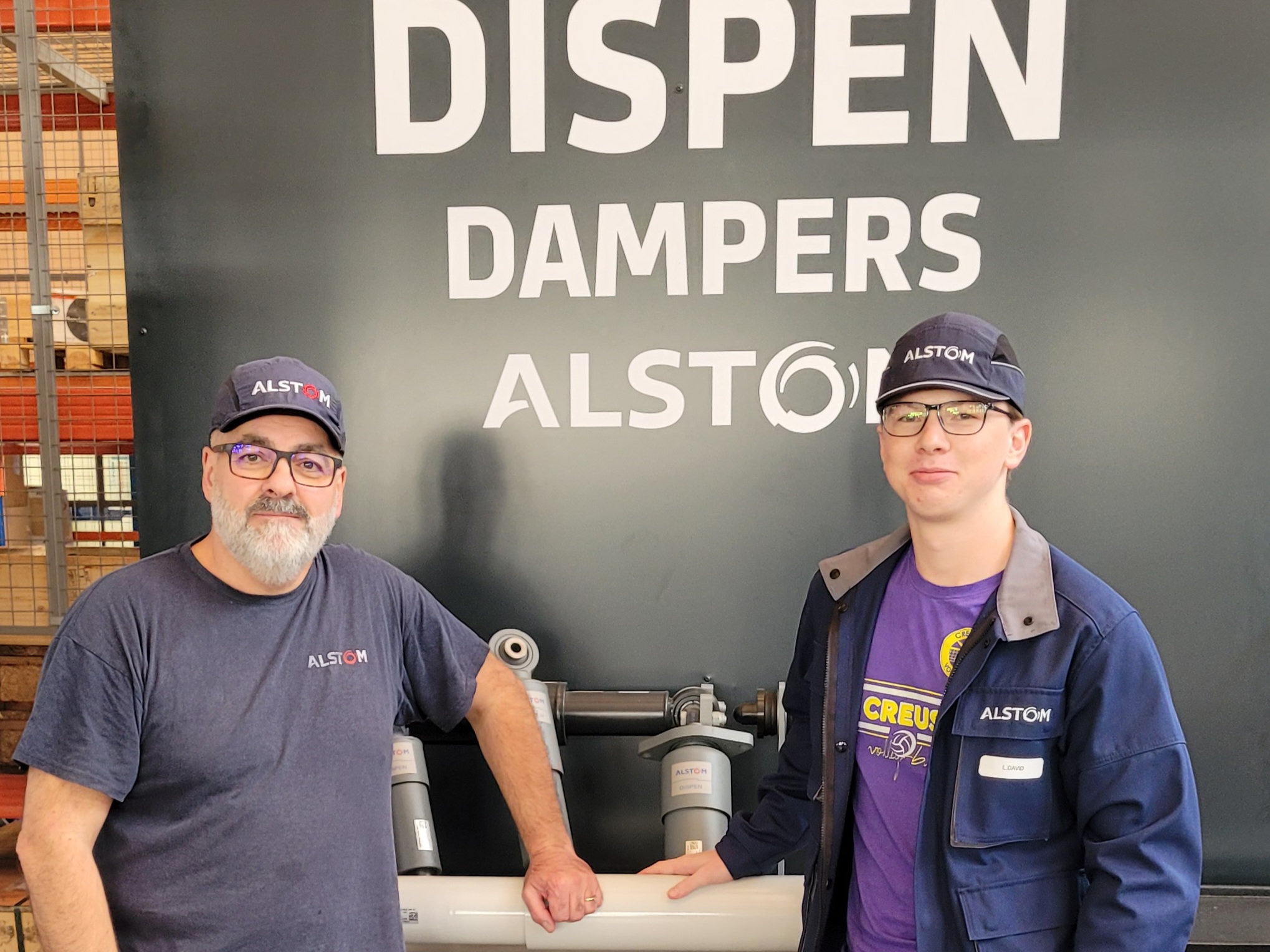
DISPEN is the part of Alstom that makes train dampers, for Alstom and for other brands' trains.
Overview
After discovering the whole production line with the operators, I focused on the robotic "Adjustment cell" to understand, measure, and mitigate its technical issues. I implemented a machine performance tracker, solved technical issues with Loïk, a technician, and began working on a new layout to allow masked-time activities. I also handled communications with employees (presenting the performance tracker, industrial experts) and vendors (the robotic cell's integrators and sales contacts).
Reduced issue occurrences by 62% between Week 13 and Week 25.
Implemented TeepTrak, with prepared automated issue reporting and tracking of about 80 different product references/types in Week 25.
Built allocated-time charts (abacuses) for robot production, which helped production planning.
Recommendations

The railway industry requires precision and trust, all the more so because our damper production is mainly dedicated to railway safety. Lucas helped us a great deal on our adjustment cell with technical issues, and studied the workstation as a whole to support a ramp-up in throughput. He did not hesitate to improve the machine, although some changes caused production stops — quickly resolved, admittedly, but avoidable. I am glad to have had Lucas as an intern.
Adjustment machine
This machine has two FANUC robots, and is tasked with screwing a valve holder that compresses a spring to a given preload on the piston/base.
It takes the pre-assembled piston, verifies the spring's stiffness, and screws the valve holder.
The parts are tiny, and the assembly was not originally designed for automated production. I helped reduce production stops by 62% by:
- Realigning taught positions
- Editing the screwing processes
- Implementing a new vision program
Role & Responsibilities
Observed and studied technical issues as they happened, going from reported symptoms to root causes.
Key Projects & Contributions
I collaborated closely with Loïk to adjust taught positions of saved recipes and to test new changes. I wrote instruction sheets so the new vision process would stay maintainable, togglable and adjustable.
I implemented TeepTrak so the production unit manager can see machine performance (TRS, TRG) and has proper tracking of technical issues.
Issues are reported by the operator for now, but automatic reports are almost functional (logic and alarms done, waiting for more PLC outputs).
I made a new vision process so the screwdriver starts aligned with the valve holder.
Improved a solution to greatly reduce cross-threading issues.
Tools, Methods & Skills
FANUC ROBOGUIDE for offline program prototyping
TIA Portal for PLC monitoring / programming
Excel for issue-occurrence analysis
Takeaways & Next Steps
This internship was full of work and required me in several domains: technical work (FANUC robotics, Siemens PLCs, mechanical issues) and communications (on site when presenting to colleagues, and externally when requesting vendor interventions or configuring a new module).
I learned some life lessons: working with many people, and finding the person on site I needed at each step (FANUC, TeepTrak, maintenance). I also found that my skills were needed beyond an internship; I am sure I can come back later and have important work to do.